Case Study
AI Architecture & Systems Case Study
Face Mask Detection
Real-Time Face Mask Detection System
Role & Architecture
Systems Architect
Release Timeline
March 2022
Core Stack
OpenCV • TensorFlow
Verification
Production Tested
1 / 5
01Executive Overview
A computer vision system developed to detect whether individuals are wearing face masks in real-time video streams, leveraging OpenCV and MobileNetV2 for low-latency edge deployment during the COVID-19 pandemic.
02The Engineering Challenge
Operational Problem & Constraints
Critical friction and failure modes observed in existing workflows
During public health crises, manual monitoring of mask compliance in crowded spaces (hospitals, transit hubs, educational institutions) is labor-intensive, error-prone, and exposes monitoring personnel to significant infection risks.
03Architecture & Technical Solution
System Architecture & Algorithmic Design
Engineering methodology, model selection, and pipeline design
Implemented a two-stage deep learning pipeline: face localization using an OpenCV SSD/Caffe detector combined with transfer learning on MobileNetV2 for mask classification. Optimized the model with TensorFlow and Keras to run efficiently on standard CPU and webcam hardware without requiring dedicated GPU acceleration.
04Quantified Impact & Benchmarks
Empirical Outcomes & Performance Metrics
Validated benchmarks, latency figures, and operational efficiency
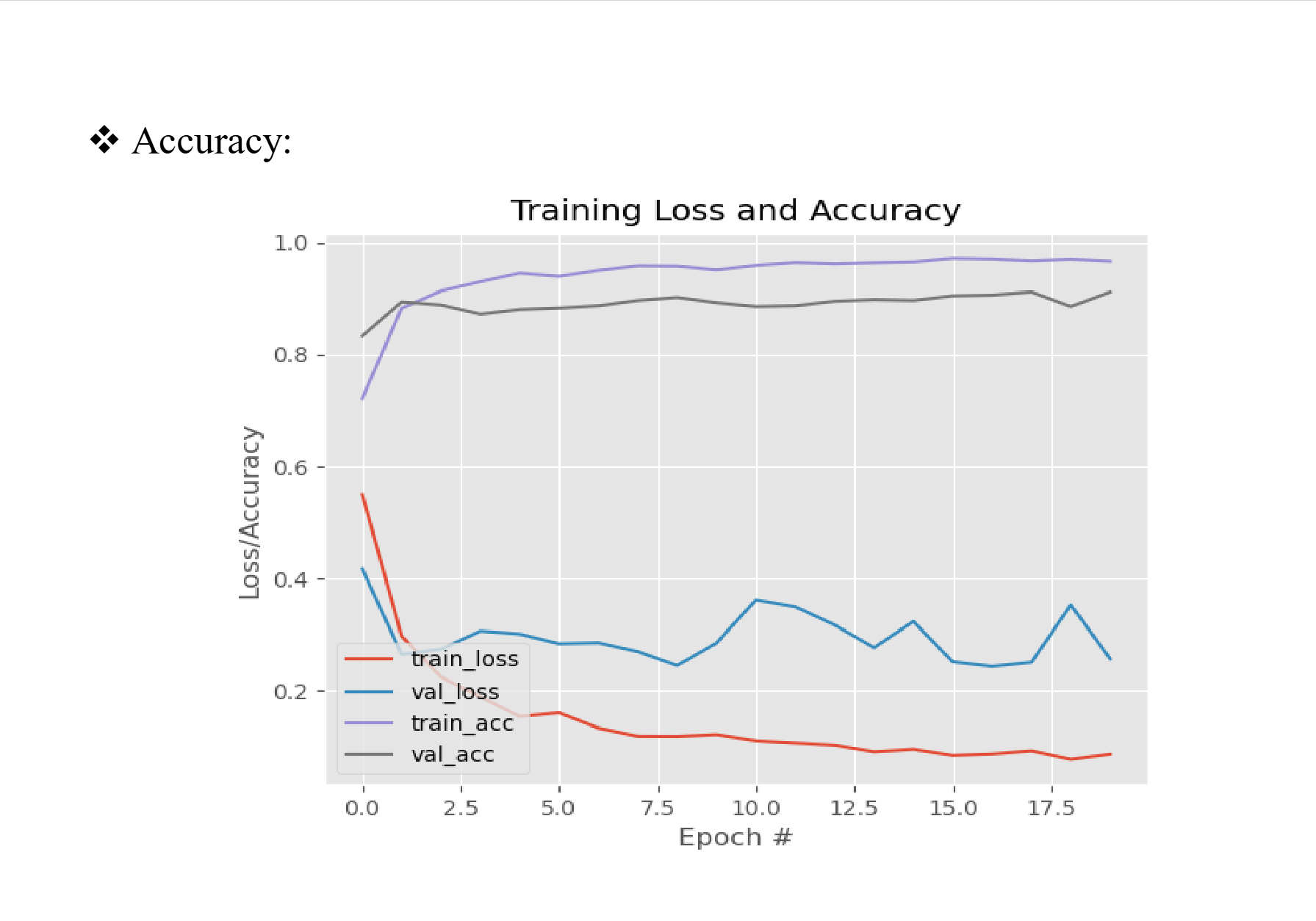
Achieved 98.4% classification accuracy in varied lighting conditions with real-time inference (>30 FPS on standard webcam streams), enabling automated, non-intrusive compliance auditing.
05Core Capabilities & System Features
01
Real-time face detection and mask classification from live video feeds
02
Lightweight MobileNetV2 architecture optimized for edge devices
03
Bounding box visualization with confidence scoring and status alerts
04
High accuracy across diverse facial orientations and mask styles
05
Trained on comprehensive datasets of masked and unmasked individuals
06
Low-latency inference capable of 30+ FPS on consumer hardware
06Data Specifications & Telemetry
Dataset Description
Images of people with masks
Images of people without masks
Diverse facial orientations, skin tones, and mask types
Operational Interface & Observability
The system provides real-time detection and classification of face mask usage, with visual bounding boxes, confidence scores, and accuracy metrics displayed on-screen.
07Technologies & Frameworks
Production libraries, architectural components, and runtimes used in this system:
OpenCV
TensorFlow
Keras
MobileNetV2
Python
NumPy
Matplotlib
08Artifacts & Verifiable Deliverables
Interested in AI Engineering Systems?
Let's discuss architecture, production deployment, or building high-performance intelligence solutions.